
Why Associations Still Struggle to Communicate Member Value
By Tamara Perry-Lunardo • November 11, 2026
Communicating member benefits effectively has ranked among associations’ top two challenges every year since 2022, according to Naylor’s 2026 Association Benchmarking Report. In last week’s article, I looked at how non-dues revenue, the No. 1 challenge, has changed shape over five years.
When our team lined up the same five years of data on member value, we found a familiar arc in how many associations name the challenge. What’s different is what sits underneath it.
By their own account, associations are reaching members more effectively than they were a few years ago; making the case for the value of membership is where they’ve made the least headway.
The Five-Year Arc
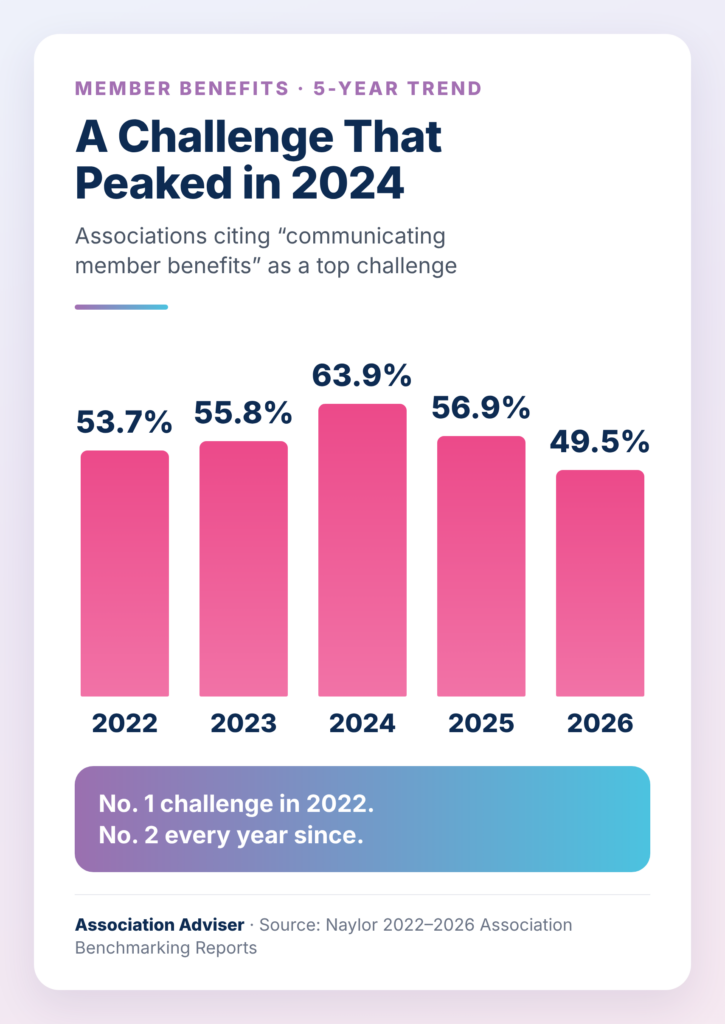
In 2022, communicating member benefits effectively was the No. 1 challenge associations named, cited by 53.7 percent of respondents; it was only the second time in the survey’s history that it had held the top spot. Non-dues revenue overtook it in 2023, and member benefits has held the No. 2 position ever since: 55.8 percent in 2023, a peak of 63.9 percent in 2024, 56.9 percent in 2025, and 49.5 percent in 2026.
If that shape looks familiar, it should.
Concern about non-dues revenue followed nearly the same path, peaking in 2024 and easing for two straight years. In 2026, only 2.4 percentage points separated the two challenges.
Reaching Members Is Getting Easier. Making the Case Isn’t.
The barriers associations cite to member engagement show where progress has happened and where it has stalled.
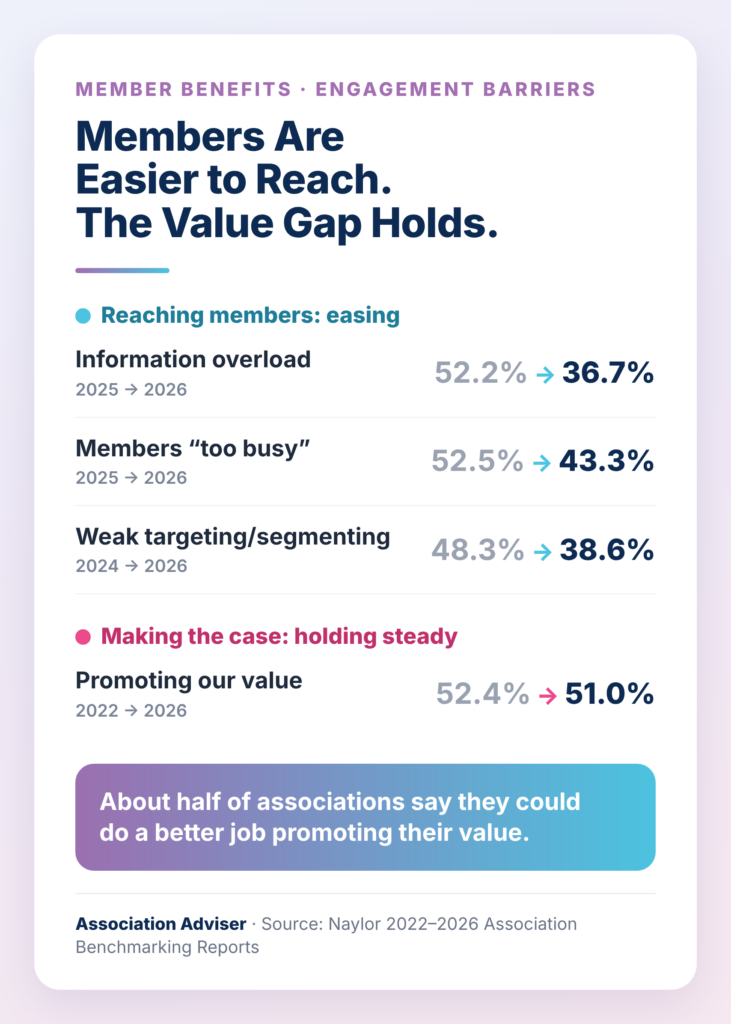
Start with delivery. Naylor’s 2025 report noted that “combating information overload/cutting through the clutter“ had been the top association challenge for almost a decade before 2022, and that year, it climbed back into the top three at 52.2 percent. In 2026, it fell to 36.7 percent, the largest drop of any challenge this year. The share of associations saying they don’t target or segment their outreach as well as they should declined from 48.3 percent in both 2023 and 2024 to 38.6 percent in 2026. And “members imply they are too busy,“ the top engagement barrier in 2024 and 2025 at roughly 53 percent, dropped to 43.3 percent.
Now look at the message itself. Every year in this five-year span, about half of associations have said they could do a better job promoting their value. In 2022 and 2026, the survey phrased it as promoting specific member benefits and the value of membership, and the numbers barely moved: 52.4 percent then, 51.0 percent now.
From 2023 through 2025, a closely related item about promoting communications as a member benefit landed in the same range, between 49.9 and 53.6 percent. In all five years, it ranked first or second among engagement barriers.
Competition for members’ attention has grown at the same time. The share citing competing options for content, events, and education rose from 37.2 percent in 2022 to 46.9 percent in 2026, after peaking at 48.6 percent in 2025.
The 2026 report describes members as “not disengaged so much as selective,” and I think that’s the most useful way to read these numbers together. Fewer associations report barriers related to cutting through clutter and reaching members. About the same share as five years ago say they aren’t making a strong enough case once they do.
Where the Investment Is Going
Spending priorities may explain part of the stall. Each year, the survey asks how associations would spend an unplanned 50 percent budget increase. Improving content strategy and curation capabilities has attracted roughly 28% to 35% of respondents every year since 2022. The 2025 report called out the disconnect directly; 57 percent named member benefits communication as a challenge, but only 28 percent would put windfall dollars toward content strategy.
In 2026, interest in launching new communication channels more than doubled, from 17.4 percent to 36.3 percent. (The 2026 survey asked respondents to choose their top five priorities, so year-over-year comparisons on this question are best read as directional.) Many of the fastest-rising tools this year, including SMS messaging, association apps, and AI-powered tools, are worth testing. A new channel works best, though, when the value message it carries is already well defined.
There’s also a shift in how associations learn what members value. In 2022, surveys led the list of tools used to understand member needs at 73.2 percent, and the association website was used by 30.9 percent. In 2026, the website (74.9 percent), email (70.7 percent), and events (66.2 percent) all ranked ahead of surveys (51.4 percent). The question’s wording has changed slightly over time, but the movement since 2024 has been steady. Surveys haven’t gone away; in fact, associations are surveying more often in 2026. As the 2026 report puts it, understanding member needs now depends as much on digital signals as on direct feedback.
What Should Associations Do About It?
So how do you close the gap between reaching members and convincing them? Here’s where I’d focus heading into 2027.
Put your improved targeting to work on the value message, not only the delivery schedule. Fewer associations cite segmentation as a barrier than in years past, which means many of you now have the capability to send different members different reasons to belong. A young professional and a 25-year member rarely value the same benefits, and engaging young professionals remains a top-four challenge at 43.0 percent. Build benefit messaging for each segment around the outcomes that segment cares about.
Let behavioral data tell you which benefits are landing. Your website analytics, email engagement, and event registrations already show which offerings members use and which they ignore. Lead with the benefits members are already choosing, and look hard at the ones they aren’t. A benefit nobody uses may have a messaging problem, or it may have a relevance problem; the data can help you tell the difference.
Fund the message before the megaphone. If new channels are on your 2027 wish list, pair them with an investment in content strategy so each channel carries a value proposition members can recognize as theirs. The associations that make progress on this challenge will likely be the ones that treat benefits communication as an ongoing strategy, with clear ownership, rather than a line in the renewal email.
Members haven’t stopped listening; they’ve gotten choosier about what earns their attention. After five years of data, associations have shown they can get the message in front of members. The work now is making sure that message answers the question every member is quietly asking: What do I get from belonging here?
How would your members answer that today?
Next week, we’ll close the series with the challenge that broke into the top three in the 2026 Benchmarking Report: leveraging data to make strategic decisions.
Source: Naylor Association Solutions’ 2022–2026 Association Benchmarking Reports.

About the Author
Tamára Perry-Lunardo is Vice President of Content Services at Naylor, where she combines her strengths as a communicator, leader, and business strategist to deliver innovative, revenue-driving content solutions to clients and serves as Editor-in-Chief of Naylor’s Association Adviser media brand. Reach her at [email protected] or connect with her on LinkedIn.
Photo courtesy of Shutterstock.com/beast01
Quick Takes
Communicating member benefits was the No. 1 challenge in 2022 (53.7%) and has ranked No. 2 every year since, peaking at 63.9% in 2024 before easing to 49.5% in 2026.
Delivery barriers eased in 2026. Information overload fell from 52.2% to 36.7%, and “members are too busy” dropped from 52.5% to 43.3%.
The value barrier held steady. About half of associations have said every year since 2022 that they could do a better job promoting their value (52.4% in 2022; 51.0% in 2026).
Interest in content strategy has hovered between 27.5% and 35% as a budget priority, while interest in launching new channels doubled in 2026 to 36.3%.
Associations increasingly read member behavior to understand needs; the website (74.9%) and email (70.7%) now outpace surveys (51.4%) .