
The Future of Association Leadership: Takeaways from the 2025 ASAE CEO Power Breakfast
At the 2025 ASAE Annual Meeting, the CEO Power Breakfast brought together association CEOs and executive directors for a candid, forward-looking conversation among leaders navigating a quickly changing world. The message was clear: adaptability, trust, and purpose-driven leadership are essential for guiding associations through complexity and toward meaningful impact.
Panelists Tip Tucker Kendall, CAE, Executive Director, National Grants Management Association; Tori Miller Liu, MBA, FASAE, CAE, CIP, President & CEO, Association for Intelligent Information Management; Larry Sloan, MBA, CAE, FASAE, CEO, American Industrial Hygiene Association; and Tamesha Logan, MBA, CAE, Executive Director, American Mensa helped set the stage for an open and thoughtful discussion by offering provocative questions for consideration:
- Should we kill the committee and modernize our governance models?
- Are we so busy preserving our mission that we forget to ask if it still matters?
- How do we reconcile our commitment to tradition with the need for transformation?
- If your association disappeared tomorrow, would your members fight to get it back?
CEO Power Breakfast panelists and moderators (L-R): CEO of American Industrial Hygiene Association Larry Sloan, MBA, CAE, FASAE; Naylor CEO & President Christine Shaw; Executive Director of National Grants Management Association Tip Tucker Kendall, CAE; Executive Director of American Mensa Tamesha Logan, MBA, CAE; President & CEO of Association for Intelligent Information Management Tori Miller Liu, MBA, FASAE, CAE, CIP; Executive Advisor of Foresight First LLC Jeff De Cagna
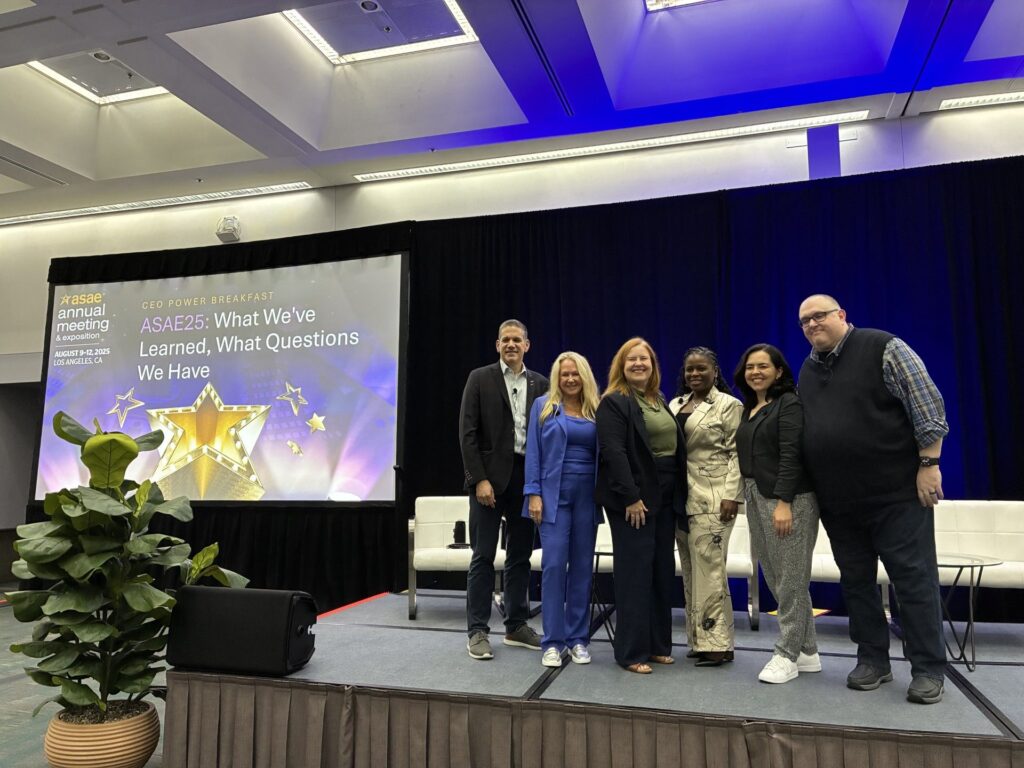
Moderated by Naylor CEO & President Christine Shaw and Foresight First LLC Executive Advisor Jeff De Cagna, AIMP, FRSA, FASAE and made all the more engaging with real-time questions from attendees, the discussion named the real tensions and questions facing associations today. The panel spoke unflinchingly about organizational challenges, AI integration and stewardship, the challenges and opportunities found in the evolving role of associations, the need for new approaches to governance and board relationships, and the emotional toll of leadership. Irrespective of organization or industry, the sentiment around the room was that the role of an association CEO or ED has never been more demanding or more crucial.
Fitting for such a genuine and transparent conversation, a major theme was the growing need to build trust. The panel spoke about how public confidence in institutions is eroding and how associations must be reliable sources of credibility and connection. Members aren’t just looking for information—they want to belong to communities they can count on.
The need for curiosity and openness was also threaded throughout the conversation. Acknowledging that associations are often perceived as late adopters, the panelists agreed it’s imperative for CEOs and EDs to lead with a learning mindset, especially when it comes to emerging technologies like artificial intelligence. Instead of fearing disruption, they need to responsibly explore how tools like AI can streamline operations, personalize member engagement, and help deliver more value. But the panelists underscored that they’re also keeping their focus on people, ensuring that digital innovation enhances, rather than replaces, the essential human element.
The conversation touched on political polarization and how associations can remain steady amid deep societal divides, as well. The group agreed it’s a balancing act: maintaining grant funding and tax-exempt status while still upholding values like inclusion, equity, and transparency. For some, that means reexamining advocacy strategies. For others, it means doubling down on being a space where diverse perspectives can be explored in good faith.
The panelists also reflected on the emotional demands of leadership. The last few years have required association executives to stretch in every direction—acting as strategist, counselor, communicator, and crisis navigator. That reality has underscored the importance of community, collaboration, and vulnerability. No CEO or ED leads alone, and moments like the CEO Power Breakfast remind leaders that they’re part of something bigger: a profession committed to collective progress.
The conversation highlighted generational change, too—not just among members, but within staff teams and boards. CEOs and EDs are rethinking everything from governance structures to workplace flexibility to meet new expectations. What worked a decade ago may not work today, and that’s not a failure—it’s an invitation to evolve.
At its core, the discussion served as a reminder that leadership isn’t just about steering through turbulence. It’s about doing so with purpose and with eyes fixed on the future. The best leaders aren’t just reacting to change—they’re helping shape it. The panelists offered these takeaways to their fellow association leaders:
- Know your “why.” Anchor yourself in purpose and values.
- Invest in your people. If your leadership isn’t about people, rethink your role.
- Focus your efforts. Say “no” more often. Set clear boundaries.
- Be emotionally agile. Accept that ambiguity and change are constant.
- Embrace multigenerational leadership. Build leadership teams that span ages and experiences.
- Prepare your organization for change. Not every association is ready for transformation — help get them there.
- Foster radical collaboration. Even with “competitors,” working together serves the greater good of the sector.
As the 2025 ASAE Annual Meeting explored the theme of possibility, the CEO Power Breakfast offered both inspiration and challenge. Just as they began the conversation with excellent provocations, the panelists concluded it with the key questions they would be reflecting on post-conference:
- Am I creating a welcoming, inclusive space for all team members?
- What is our globalization strategy—and is it meaningful?
- How do we stay relevant as a nonprofit in a shifting landscape?
- What more can we do to elevate board performance and engagement?
- Are we prepared—structurally and emotionally—for this level of disruption?
The possibilities for associations are exciting, and unlocking them requires courage, humility, and a willingness to grow. This is a moment of transformation, and the future of associations will be shaped by those willing to lead with both vision and heart.

