Features Association Benchmarking Series Membership

How Can Associations Use Data to Make Strategic Decisions?
By Tamara Perry-Lunardo • November 18, 2026

In the first two installments of this three-part series, I looked at the top two challenges associations reported in Naylor’s 2026 Association Benchmarking Report: generating non-dues revenue and communicating member benefits effectively. Both followed a similar arc over five years, peaking in 2024 and easing since. The third challenge breaks that pattern.

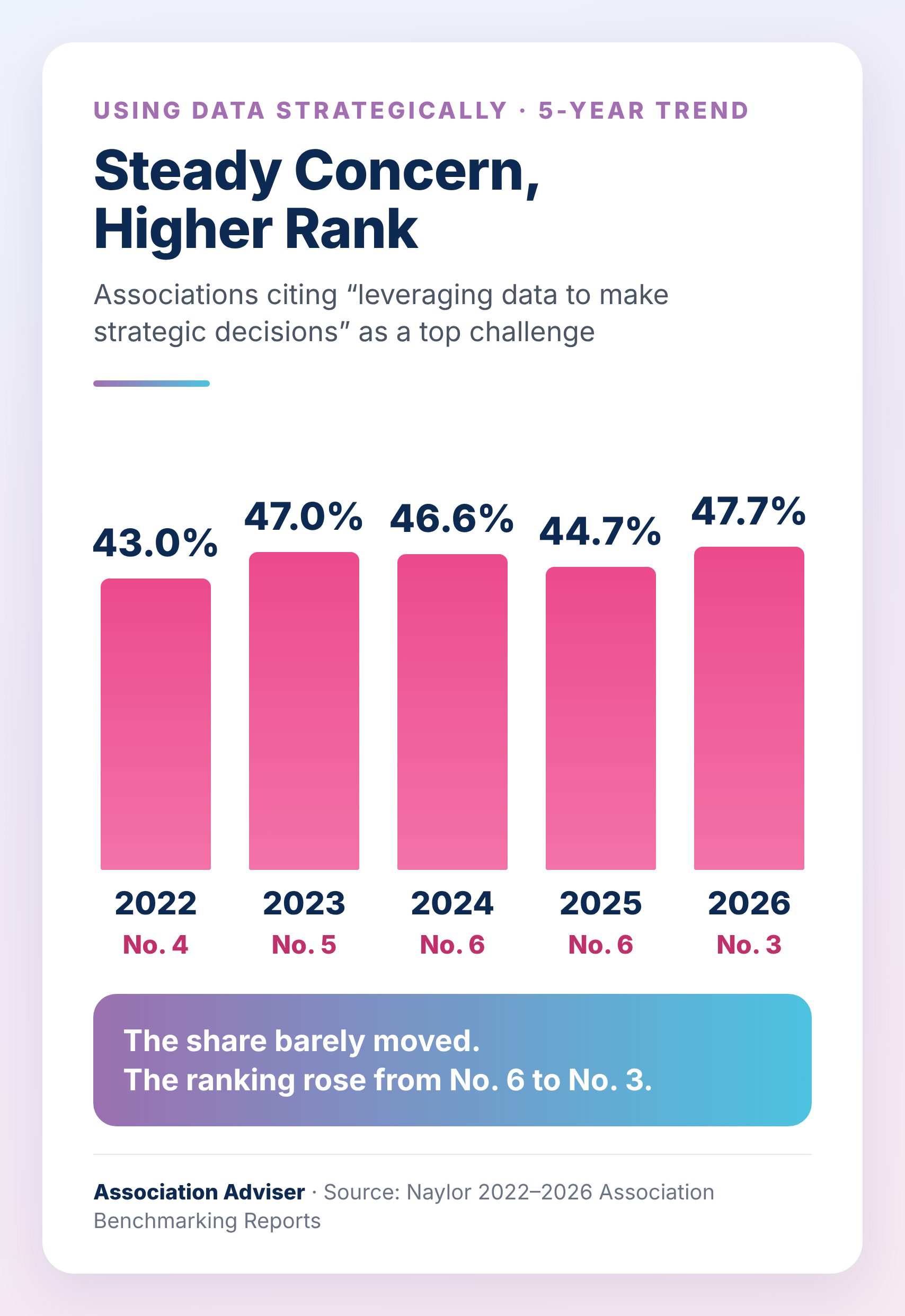
“Leveraging data to make strategic decisions” climbed from No. 6 to No. 3 in 2026, which the report calls the biggest shakeup in this year’s rankings. That jump surprised me at first. Looking back over five years, though, between 43 percent and 48 percent of associations have identified it as a challenge every year since 2022. The concern itself hasn’t grown much; it ranks higher now because other challenges eased in 2026.

Five-year trend in associations using data to make strategic decisionsA Persistent Concern

In 2022, 43 percent of associations named using data to make strategic decisions as a top challenge, which ranked it No. 4. Over the next four years, that share stayed within a five-point band: 47.0 percent in 2023 (No. 5), 46.6 percent in 2024 (No. 6), 44.7 percent in 2025 (No. 6), and 47.7 percent in 2026 (No. 3).

By contrast, the challenges around it eased in 2026. Concern about non-dues revenue fell from 61.0 to 51.9 percent; information overload dropped from 52.2 to 36.7 percent. Data moved up the list largely because other pressures let up. That makes it the one challenge in this series that hasn’t peaked and receded; nearly half of associations have wrestled with it every year.

More Data Than Ever

Gathering data isn’t the bottleneck it once was. The share of associations citing an “inability to collect/use member data effectively” as a barrier to engagement peaked at 34.1 percent in 2023. By 2026, it was back down to 24.1 percent, about where it stood in 2022 (24.9 percent).

The sources of insight have also multiplied. In 2026, associations named their website (74.9 percent) and email engagement data (70.7 percent) as their top sources for understanding member needs, followed by events and social media. AI is adding to that flow. The share of associations reporting no use of AI-powered communication tools fell from 64.2 percent in 2024 to 21.0 percent in 2026, and frequent or daily use rose from 6.7 percent to 33.5 percent over the same two years.

The 2026 report puts the result plainly: “it’s no longer enough to collect data; leaders need real-time insight they can put directly to use.” Associations have more ways to see what members are doing; now, deciding what those signals mean is where many are getting stuck.
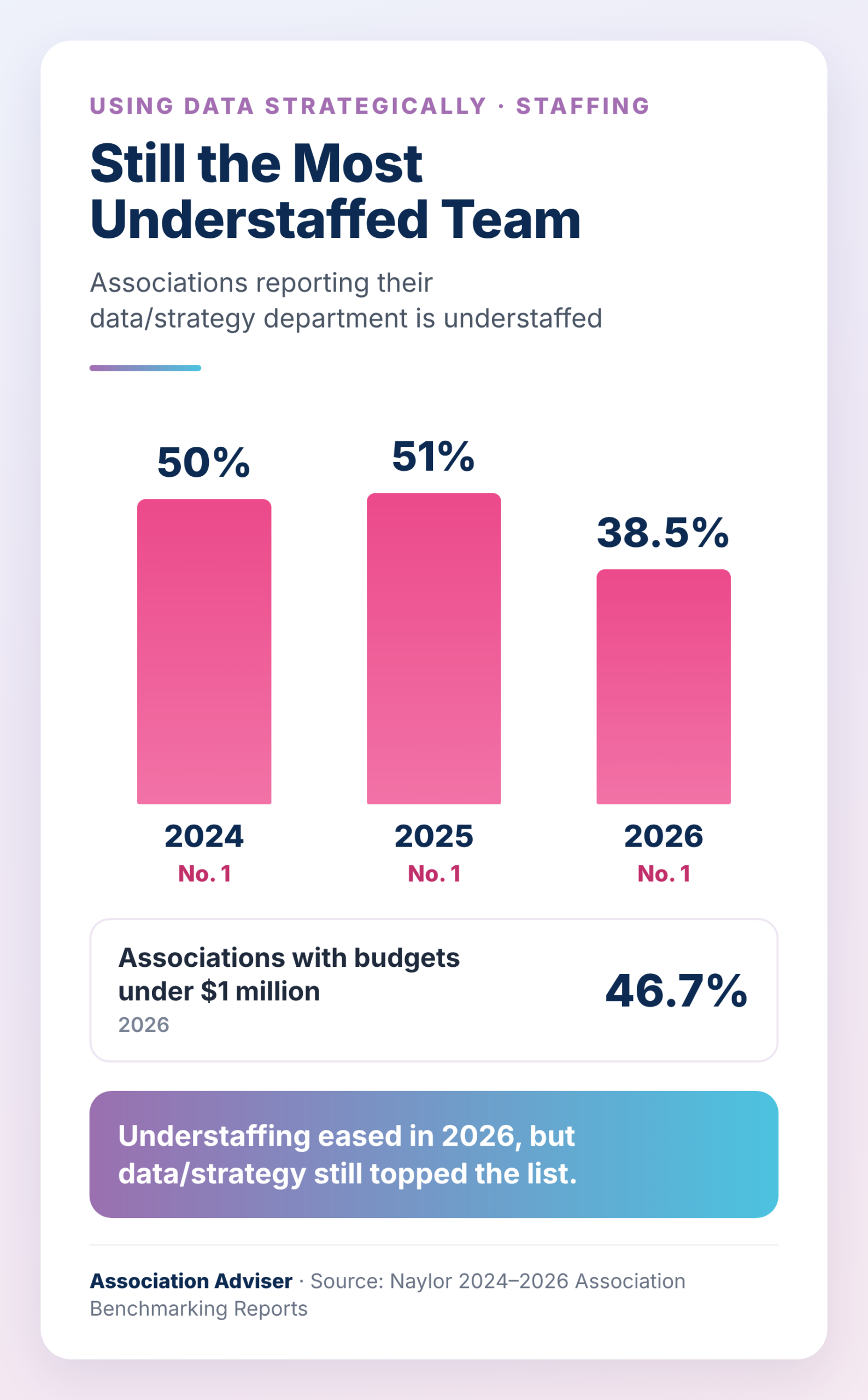
Data and strategy capacity challenges among associations

The Capacity Gap

The people and budget needed to interpret those signals haven’t kept pace with demand. Data/strategy has ranked as the most understaffed operational area for three consecutive years; 50 percent of associations reported understaffing there in 2024 and 51 percent in 2025. In 2026, that share fell to 38.5 percent as staffing pressure eased across nearly every department, but data/strategy still topped the list. Among associations with annual budgets under $1 million, it was 46.7 percent.

Investment hasn’t followed, either. When asked how they would spend an unplanned 50 percent budget increase, between 22 and 30 percent of associations chose to implement or improve data strategy from 2022 through 2025. In 2026, that share fell to 18.4 percent, the lowest in five years. Some associations are looking for outside help instead; outsourcing of member data management rose from 4.4 percent to 11.0 percent in 2026.

One more signal is worth watching. In 2026, the share of associations using each of the five most common measures of member engagement dropped from 2025, including event attendance (91.7 to 73.5 percent) and email metrics (69.1 to 54.7 percent). The survey doesn’t tell us whether associations are narrowing their focus to fewer, better measures or feeling less certain about what to track. Either way, it’s a question worth raising inside your own association.

What Should Associations Do About It? 

For most associations, the next step is figuring out what they actually need their data to tell them. Here’s where I’d focus.

  1. Start with typical decisions your association makes annually, and work backward. Create a list of these decisions, which could include things like renewal pricing, which events to keep, which benefits to promote, and which sponsor packages to offer. Then, identify the two or three data points that would make each decision easier. The first two articles in this series looked at non-dues revenue and member value; both depend on data that provides insights on offerings that members and partners use.

  2. Give data a named owner. With data/strategy listed as the most understaffed function for three years running, many associations have the analytics but no one with time to interpret that data. That owner might be a staff member with protected hours, a cross-department group that meets monthly, or an outside partner. Someone needs to be accountable for turning reports into recommendations. 

  3. Put AI to work on interpretation. With a third of associations now using AI tools frequently or daily, many already have the capability to summarize engagement trends, flag changes in member behavior, and draft first-pass analysis for staff to review. Human judgment still belongs at the decision point, but AI can help you get there more efficiently.

Data Is the Key  

An important thread runs through all three articles in this series: Associations want to grow non-dues revenue and show members why belonging is worth it, and both goals depend on understanding what members and partners value. Data is how associations find that out. In 2026, nearly half said turning data into decisions is one of their biggest challenges; at the same time, their tools, data sources, and overall staffing are in stronger shape than they’ve been in years.

As you plan for 2027, the question to consider may be how to better leverage these assets to turn your association data into revenue-driving, value-delivering decisions.

Source: Naylor Association Solutions’ 2022–2026 Association Benchmarking Reports. 

About the Author

Tamára Perry-Lunardo is Vice President of Content Services at Naylor, where she combines her strengths as a communicator, leader, and business strategist to deliver innovative, revenue-driving content solutions to clients and serves as Editor-in-Chief of Naylor’s Association Adviser media brand. Reach her at [email protected] or connect with her on LinkedIn. 

Photo courtesy of Accogliente Design/Shutterstock.com

Quick Takes

  • “Leveraging data to make strategic decisions” ranked No. 3 in 2026 at 47.7%, up from No. 6, though the share citing it has stayed between 43% and 48% since 2022.

  • Collecting data is less of a barrier; the “inability to collect/use member data” fell from 34.1% in 2023 to 24.1% in 2026.

  • AI adoption accelerated; associations reporting no AI use fell from 64.2% in 2024 to 21.0% in 2026.

  • Data/strategy has been the most understaffed department for three years running (50% in 2024, 51% in 2025, 38.5% in 2026).

  • Data strategy as a budget priority fell to 18.4% in 2026, its lowest point in five years.