
Revenue Follows Value: Lessons from the 2026 CEO Power Breakfast
On the final morning of the 2026 ASAE Annual Meeting, association CEOs and executive directors gathered for the CEO Power Breakfast, hosted by Naylor Association Solutions and moderated by Naylor CEO & President Christine Shaw. The panel brought together leaders from four very different corners of the association world—golf course ownership, chamber of commerce management, ready-mixed concrete manufacturing, and real estate management—for a candid conversation about revenue, membership, and what really earns a member’s trust.
Despite running associations with almost nothing in common on paper, the panelists kept circling back to the same principle: revenue follows value, and member value must be demonstrated and communicated, not assumed.
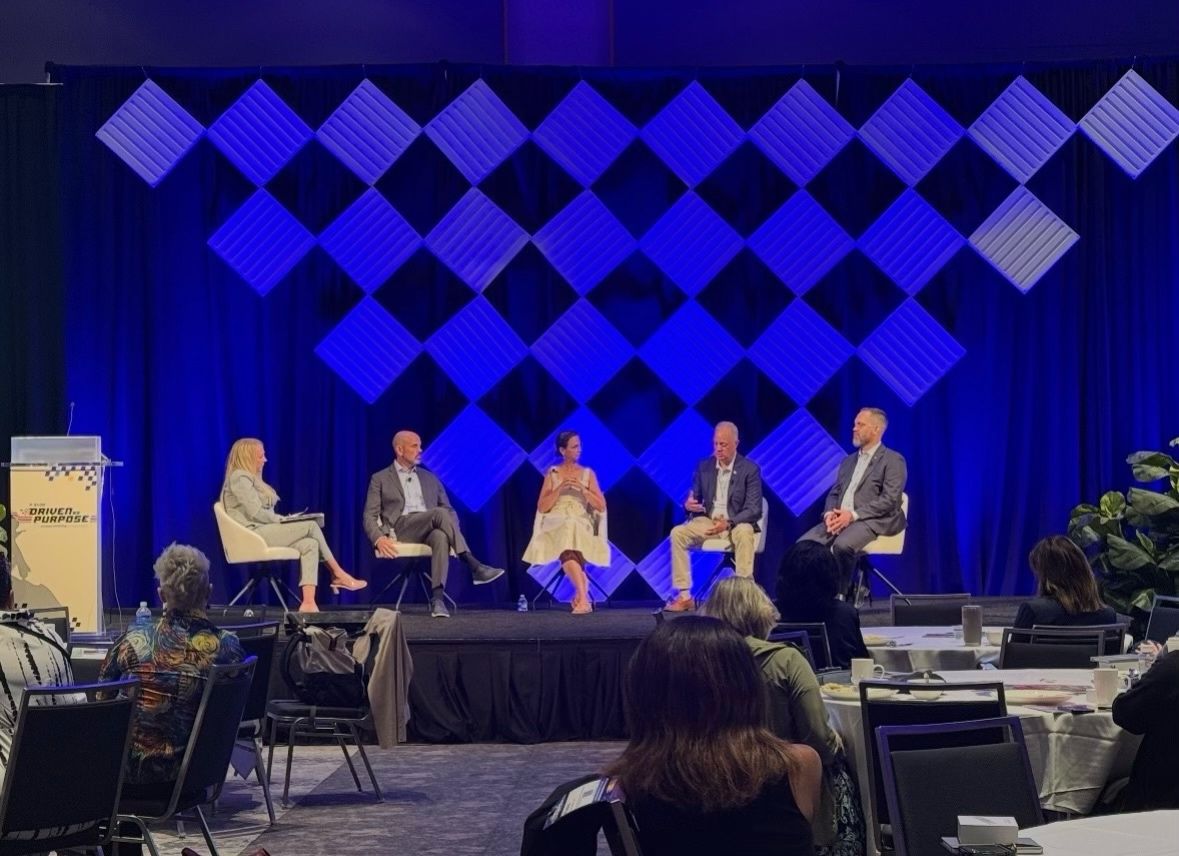
CEO Power Breakfast panelists and moderator (L-R): Naylor CEO & President Christine Shaw; CEO of National Golf Course Owners Association Jay Karen, CAE; President & CEO of Association of Chamber of Commerce Executives Sheree Anne Kelley; President & CEO of National Ready Mixed Concrete Association Jim Riley, Esq.; and CEO/Executive Vice President of Institute of Real Estate Management Zack Wahlquist, FASAE, CAE, RCE.
When Members Don’t Know What They Need
Member surveys tell you what people think they want, but the panel agreed that those results don’t always match what members actually need. Providing real value to members takes more digging than a satisfaction survey provides.
The panel agreed that members often can’t articulate the benefits they’re getting from their membership until renewal forces the question. They join for a reason but rarely stop to weigh the value of their membership, so by the time a budget conversation puts the price of dues under scrutiny, the association is scrambling to prove value that it should have been communicating all along.
Different Sectors, Different Revenue Logic
There’s no single non-dues formula that works across industries, and the panel’s own portfolios made that clear.
For Jim Riley, President & CEO of the National Ready Mixed Concrete Association (NRMCA), the association’s industry laboratory and certification programs anchor non-dues revenue, and that money flows straight back into new lab equipment and credentialing software. It’s a direct loop: members benefit from services, and the money those services generate improves them further.
For Zack Wahlquist, FASAE, CAE, RCE, CEO & Executive Vice President of the Institute of Real Estate Management (IREM), education and credentialing products are the association’s largest non-dues driver. IREM is now working to build a lower-cost entry point into that credentialing track, aiming to bring in members earlier in their careers without diminishing the value of the full designation.
What Stays Public vs. What Goes Behind the Wall
As AI makes generic information easier to find for free, several panelists said they’re rethinking what belongs behind a member-only wall. Content that used to be given away for visibility is increasingly treated as a retention asset instead—something curated and vetted that a member can’t simply find with an online search.
The exception the panel carved out was advocacy content. Information tied to an association’s public policy work tends to stay open because visibility itself serves the mission. The association wants everyone to see what it’s fighting for, including prospective members it’s hoping to convert.
Riley pointed to another way associations are rethinking content strategy and non-dues revenue: bringing in a third party to produce content that’s then sold to members, rather than relying solely on internal staff time.
Value That Members Can See and Feel
Jay Karen, CAE, President & CEO of the National Golf Course Owners Association (NGCOA), described a giving program the association built specifically to fund legal and advocacy work beyond what standard dues support. He gave the example of legal work helping golf courses update their online booking terms and conditions as AI-driven tee-time tools introduced new liability questions, alongside support defending premises-liability lawsuits that could set costly precedent across the industry.
Sheree Anne Kelly, President & CEO of the Association of Chamber of Commerce Executives (ACCE), pointed to a different kind of advocacy: not policy work, but making the case for the chamber itself. A 2024 Harris Poll conducted on ACCE’s behalf found that 81% of U.S. adults consider their local chamber a trusted resource and partner for businesses. Kelly described putting that statistic in chambers’ hands so they can make the case to local businesses that joining is worth it.
The shared lesson: give members something concrete.
That same emphasis on tangible value extends to how Karen treats NGCOA’s commercial partners—a vendor advisory council that gives suppliers a real voice, and a podcast that highlights vendors for their expertise rather than their ad spend.
Engagement Beyond the Newsletter
For Wahlquist, IREM’s 83 chapters are the association’s strongest engagement lever—the chapters are hyper-local, providing a peer-to-peer connection that outperforms anything delivered top-down from national. Karen described a similar instinct at NGCOA, where segmenting members by shared circumstances, such as owners operating at a larger scale, creates the kind of peer conversation members say they value most.
Kelly pointed to ACCE’s Horizon Initiative, ongoing research into how and why people engage with organizations, as a way the association is tracking a generational shift in the reasons people join in the first place. The research points to changing ideas about belonging and community, not just transactional membership value.
Underneath all of this was a generational shift that the panel returned to more than once. Younger members and staff increasingly want a role in shaping direction. The panelists’ advice was to integrate next-generation members into existing board seats and committees from the start rather than routing them into a separate young-professionals track that keeps them at arm’s length from decisions that impact them.
The Common Thread
The panel discussed four very different revenue models with one shared imperative: value must be proven and communicated continuously. Whether an association’s income leans heavily on dues or almost entirely on non-dues sources, the panelists agreed that members stay when they can see what they’re getting, and when what they’re getting is actually what they need.
